Thursday, November 9, 2017

More of Alley Oop's Friend's Cars (Bob Minutello)


Another of Frankie's friends whom I met at his house
was Bob Minutello of Richmond Hill
(correct spelling of names not guaranteed)
who owned this stock-looking '59 Chevy convertible.


It sported Plymouth wheel covers, plumber's pipes
behind the front wheel openings, and a 4.88 rear end.
Inside can be seen a Sun tach and Hurst shifter for the three-speed trans,


Under the Hood was a 348 cubic-inch mill with three carbs.


More of Alley Oop's Friends Cars (Jim Mongelli)


My previous blog post remembers cars owned by Frank Gesuldo,
otherwise know as Alley Oop. I'd often meet some
of Frank's friends when I hung out at his house and
that's where I met Jim Mongelli, from Glendale, Queens
(correct spelling of names is not guaranteed).

Jim owned and built this '55 Chevy Corvette
featuring some novel bodywork over the headlights,
a modified grille and housing, and '59 Caddy
tail-light lenses in the rear, among other things.
It was painted candy-apple red;
I'm sorry I couldn't afford color film at the time.


The engine in Jim's 'Vette was a 327 Cubic-incher
with a fuelie cam, solid lifters, dual quad carbs, and
it was mated to a beefed-up Powerglide.


The Legend of Alley Oop


One of my friends from the 1960s was Frank Gesualdo but,
because he was a big burly-looking guy, everybody called him Alley Oop
(after the comic strip character of the same name).
He lived on 125th Street, near Idlewild Airport
(today JFK International) and was totally into cars. Although
I've featured a couple of his friends' cars back in my June 23, 2011 post,
I've never gotten around to showcasing Frankie's cars
(all of which, by the way, are named "Alley Oop").


The only photos I have of Alley Oop I ("the first")
were given to me by Frankie around 1962 and show his
'54 Olds with slight body modifications and a De Soto grille.
Under the hood, the engine was bored out to 4-inches, with
two quads feeding the fuel, mated to a Caddy La Salle gearbox.


Alley Oop II was a 1951 Olds bubble coupe
with trips and an automatic;
unfortunately, I never got photos of that car.

A 1958 'Vette became Alley Oop III;
when Frankie bought it, it had only slight body modifications
but was destined to become one of the meanest cars around.


(Note my primed '50 Merc, the "Mint Julep II," in the background.)


Extensive bodywork included dechroming,
rolled front and rear pans, a big hood scoop and
a bolt-on tow-bar (for trips to Westhampton Drag Strip).


 The engine was a 283 cubic-incher, bored out to 297;
it used dual quads, a dual-point centrifugal advance distributor,
and an Isky track grind cam, running through a
four-speed trans and a 4.88 posi rear.
This combination netted Frankie over twenty trophies at the strip,
some of those runs captured on 8 mm movie film
currently in my archives.


The 'Vette was eventually sold but that engine was
swapped into Alley Oop IV, a '55 Chevy 2-door hardtop.


Next in this family tree was Alley Oop V,
a '61 Chevy hardtop with a functional hood scoop,
partial dechroming, and a rolled & pleated blue & white interior.


The engine was a 348 cubic-incher with three carbs,
an Isky cam and solid lifters, and a Mallory ignition.
(If the engine photo looks a little strange, it's because
it's a double exposure with a bulletin board in my old bedroom;
don't ask me how that happened.)


I eventually married and moved to Elmont, Long Island,
and soon discovered that Frankie had married and
moved to the same neighborhood.
At that time, he owned a black '65 Chevy Impala.

It was pretty much stock-bodied, with a
327 c.i., 300 h.p. engine and a 4-speed trans.


Within ten years, I moved to East Meadow and
somehow lost touch with Alley Oop over that time.


Sunday, August 6, 2017

That Pond in Forest Park

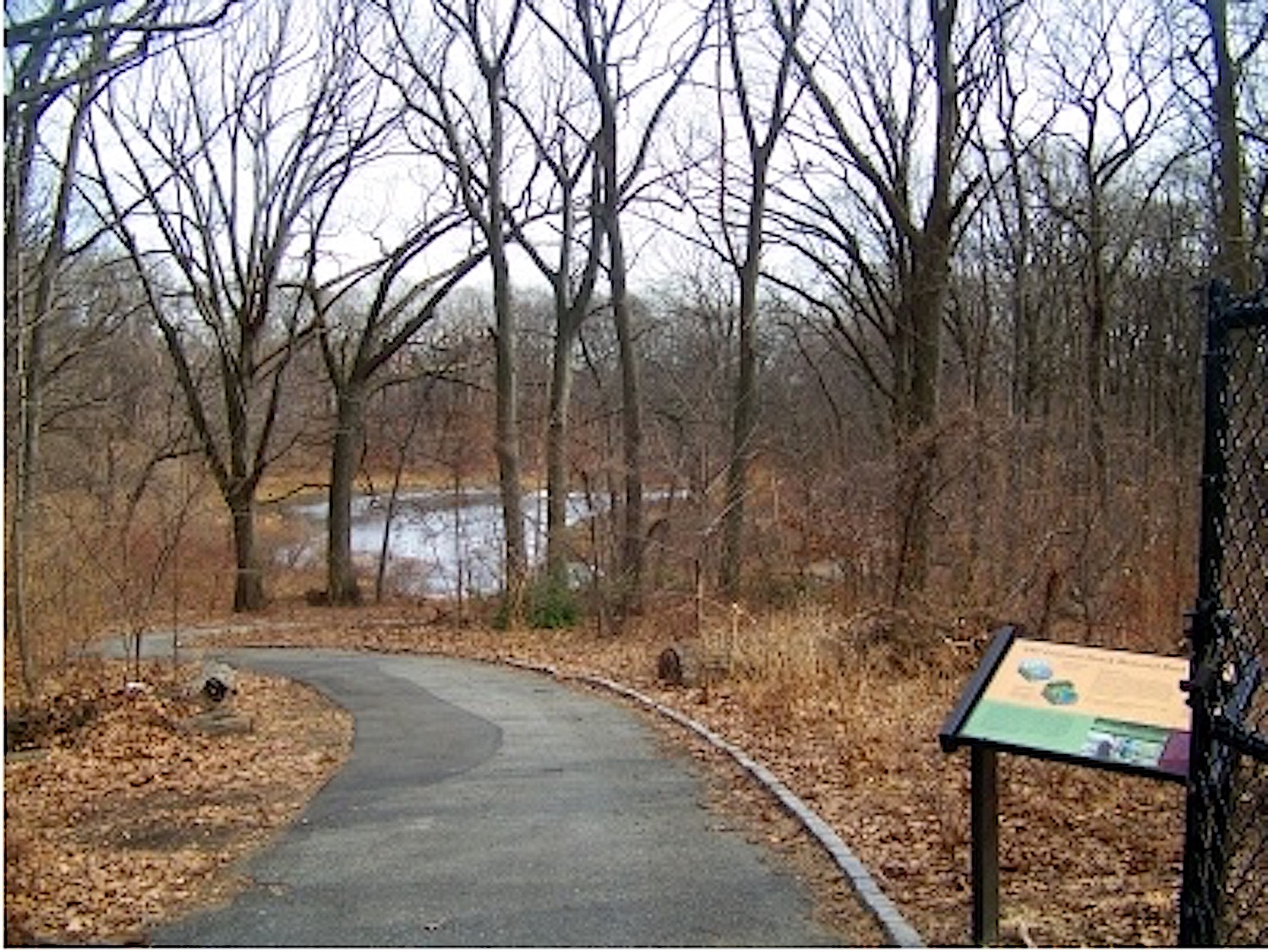
How about a place that once existed, then it was no longer there, and now it’s back again? I’m talking about the large pond that used to be in a hollow across from the carousel in Forest Park, Queens.

When I was a kid, we used to walk – or ride our bikes – to this 538-acre wilderness in the center of one of the largest boroughs of New York City. A couple of winding roads used to let you drive through the heart of this pastoral and picturesque green space but half of them are now closed to vehicular traffic so that walkers, joggers, and bikers can have more safe spaces. Back in the day, we used to ride our bikes all over this place and, especially, directly through the woods on hilly trails.

One of our favorite destinations was this natural pond that I’ve lately discovered was actually a kettle pond left over from retreating glaciers during the last ice age. Over millennia, this depression filled with rain water and, during the 1950s, my friends and I used to sail boats there or try catching fish. It was about forty feet below the level of the nearby road. Looking back, it’s amazing that we didn’t kill ourselves riding our bikes down the steep dirt hills leading to the water’s edge.


Around 1966, some genius in the NYC Department of Parks thought it would be a great idea to drain the pond and create a couple of ball fields in its place. They named the Twin Fields after PFC Laurence Strack, a boy who use to play hockey on the frozen pond – and the first local resident to be killed in Viet Nam. This was shortly after I moved out of the area but I used to return to see family and friends. So, when I saw the ball fields during one of my visits, I thought, “That’s never going to work; they’re constantly going to get flooded every time it rains.”

Well, guess what? That’s exactly what happened.

In 1994, Marc Matsil, chief of the parks department natural resources group, and Parks Commissioner Henry Stern, visited Forest Park to survey Twin Fields. “It had rained a couple inches literally two weeks before, and right field was about 5 feet underwater and left field was 4 feet underwater,” said Matsil. Stern, he said, turned to him and commented, “Those are black ducks in right field and those are mallards in left field, aren’t they?”

It was then that they decided to restore the area to its former glory and remove the ball fields and the fill that had been laid down, and replant the entire area with native plants and trees. Today, the area is even more lush than I remember it from my childhood because all the original trees that were surrounding the pond (or ball fields) are now huge, and all the new growth has filled in beautifully. On a recent visit, I saw lots of turtles in the renewed pond but I don’t know if there are any fish; I guess they would have to be stocked, wouldn’t they?


The path leading from the road to the pond.
(Parks Department photo)

 My photo from a recent autumn visit.

 My photo from summer, 2017.

 My photo from summer, 2017.

 Google Earth photo with Strack Pond visible within white oval.


Sunday, November 9, 2014

Sunken Gardens Tourist Court


I noticed a few other people online looking for signs of the old Sunken Gardens, on highway 30, about 4 1/2 miles east of Gettysburg, PA. Since I had some old photos (and a post card) from my visits there in the 1950s and 1960s with my parents, I thought I'd post a few on my blog.

(As always, click on any photo to enlarge it.)

This post card was from our first visit there July 9-13, 1956.

Back in the 1950s, color film was pretty pricy
to buy and develop
so most people shot black and white photos.

Individual photo of a single, detached cabin.

My mom and me (on right) with two kids whose parents
ran the place; posed on a large rock in the
garden with a cabin in the background.

I remember there was a railroad that ran behind Sunken Gardens;
I used to go back there with some local kids and put pennies
on the tracks before a train came through to flatten them out.
If I can find them, I'll post a photo or two.

The line of cabins (singles and doubles)
with the great lawn in front.

A double (attached cabins) during our 1960 visit;
my father on left, uncle and aunt center and right.

My parents and uncle on "the rock."

My folks in the gardens (I believe the highway is on the left).

Overview of the gardens with highway on left.

I'm sure Sunken Gardens is no longer around
(at least not in the form I knew it).
If anyone knows what it looks like today
(or what's been built in its place), please let me know;
if anyone has current photos of the site, I'd be glad to post them here. 

Sunday, June 22, 2014

Orphans Car Show, June 22, 2014 - Massapequa, NY

The "Orphans" car show, for makes and models
not being made any more.
Some beautiful cars at the show this time around,
and most in excellent condition.


Above & below: 1941 Studebaker
looks to be in mint condition!


Below: This very rare 1951 Nash Rambler Custom is
the first rail-top convertible I've ever seen;
in amazing condition.


Below: 1951 Studebaker;
I've seen this quite often here on Long Island. 


Below: Extremely rare 1962 Ghia
(built on a Chrysler/Dodge chassis and driveline
 in Italy by Giacinto Ghia).


Below: Willys Jeepster.


And, of course, an AMC Pacer (below).


Thursday, June 19, 2014

A Class Act (of crime)


For most of my life, I worked full-time as an automotive technician (aka: auto mechanic). I'd worked at gas stations, independent repair shops and various new car dealerships before landing a position at a Porsche-Audi dealer in the 1980s. When I first started working there, I didn't know much about German cars but they sent me to school and, eventually, I became a master Porsche-Audi technician... a pretty impressive addition to my resume, considering how complex those cars can be.

Of course, the owners of those luxury cars are usually pretty well-off and, over the years, I'd seen and heard of some pretty crazy things. One day, for example, a limo pulled up to our building and a young woman - probably just out of high-school - jumped out, ran into the showroom, and ordered a brand new Porsche: a graduation gift from her parents. After all the papers were signed, she hopped back into the limo before riding off into the sunset. Another time, some guy walked into the showroom and bought a new Audi paying all cash, dumping wads of bills onto the salesman's desk. Then there was the Porsche we were working on that required special parts so the job was delayed for a couple of weeks; the owner stopped by one day to check on our progress.

"Man, I'm paying $400 a month and I can't even drive the damn car," he said. 
"$400," I replied, "is that your monthly payment on the car?"
"No, no... the car is paid off; that's my insurance premium."

Throughout my career as a mechanic, I always took my lunch break. Sometimes I'd walk down the street to a local cafe, other times I'd get some Chinese food or pizza. Once in a while, I'd bring a sandwich from home or a deli; on those days, I'd usually sit in my van, eat my lunch while listening to the radio or reading something, and maybe take a nap afterward before returning to work.

On one of those days that I had a sandwich and soda in my cooler, I was sitting in my van in the back parking lot by work. A stretch limo entered the parking lot, rolled slowly past me as I looked up from a magazine I'd been reading, and I watched as it stopped by the back door to our shop. A well-dressed young guy got out of the limo, walked into the building, and a few minutes later, re-emerged, waving to the limo driver. He then walked over to a silver Porsche 911 that had been brought in for service, opened the door, got in and drove away with the limo following him. I continued to enjoy my lunch and eventually returned to work, looking forward to 4:30 and a chance to go home.

Later that same afternoon, I looked up from whatever car I was working on to see a couple of Nassau County cops walking through our shop. After continuing on to the area where the showroom and offices were located, they came back into the shop accompanied by our service manager; he called all of the service personnel to a meeting right in the middle of the shop and explained what was going on.

It seemed someone had stolen one of our customer's cars; a silver Porsche 911. He wanted to know if anyone had seen any suspicious-looking characters in our building or lot. As soon as I heard which car had been taken, I knew I was an eye-witness to the crime without even knowing it. Of course, I explained exactly what I had seen and described - as best I could - the guy who had taken the car. But I really didn't look very closely at him... why would I? I figured it was just another customer picking up his car. And, no, I didn't get a license plate number from the limo; why should I do that? Nothing that happened looked out-of-the-ordinary to me.

So, what made this crime so easy to commit? Well, whenever a car was brought in for service it was inspected for damage by a car-jockey, then a numbered tag was hung from the inside rear-view mirror and a same-numbered tag attached to the keys before it was parked. Whenever the car wasn't being worked on, the keys were hung on a large board (in numerical order, with all the other car keys) in the hallway leading from the shop to the showroom - an area open to anyone. Anyone with basic knowledge of the setup would have no problem walking into that hallway - especially during lunch hour when most employees are not around - and taking whatever keys they wanted. And, of course, the numbered tags, hanging from the mirrors of the cars in the lot, clearly identified each car.

I don't know if that thief or the Porsche were ever found. For all I know, the car could have been shipped to some South American drug lord or cut up and sold for parts. I do know that the key board was moved to the service manager's office after that day... yes, closing the barn door after the horse had escaped.

After working at many different places throughout my life, the job at the Porsche-Audi dealer lasted the longest: eleven years. I also learned a great deal during my time there – about cars and people – and how sophisticated criminals can be. I learned the true meaning of “white collar” crime.